Can we use AI to uncover the truth?
AI is a tool that can be used by others to enslave us,
or we can use it to help create Digital Freedom.
The ability of AI to work with unstructured data, process and evaluate vast amounts of data at speeds and scales that would take humans multiple lifetimes to achieve, handle complex analysis, and recognise patterns means we will be able to connect dots that otherwise we would never find.
This video provides an excellent introduction to the Bayes Theorem, a mathematical formula for calculating the probability of something.
https://www.bitchute.com/video/ZI0vmegBwZma
The Theorem is mathematical in nature and unbiased, but only as good as the information it provides. In some of the examples the video provides, I would suggest that the theorem was not given enough data.
The theorem is already the foundation of how LLMs decide which results are most relevant.
The thought occurred to me that the theorem could be used to determine the likely probability of something being true for just about anything from simulation theory to conspiracy theories.
The theorem is available via AI services like Open AI where you can provide data sets and request they be applied and produce probability reports.
The problem with Open AI and other “closed source” generative AI provided by Big Tech is that they do not have all the data and are biased (Open AI has its woke Guard Rails)
There are real Open Source models that might also know how to apply the theorem and would not be biased like Big Tech, but they also do not have all the data.
Can We Build Our Own?
I believe it would be possible to build an AI tool that simply applies the theorem only to the information provided and not very difficult to do.
I have been developing AI-powered Virtual Assistants that reside on a server I control using FOSS applications to create and manage the Assistants, and a separate Vectorised database for the data.
I am currently still using Open AI for my backend LLM processor but it does not have any direct knowledge or control over the dialogue anyone has with the assistant. That all happens on my server.
The LLM only receives the prompts which I can also apply pre and post-processing such as applying filters. I could do things like substituting terms that might hit the guardrails and then restoring them for the output. This also means that the backend LLM has no knowledge of the user who can be completely anonymous.
What really makes this idea viable is the ability to create your own database where all data is uploaded and used as the prime source for all data to be evaluated by the theorem.
The only access the backend LLM has to the database is through a requested query that is confined to the narrow parameters of the query. In other words, the backend LLM has no ability to see the database outside of the parameters of the query (the specific thing it’s searching for).
How could it work?
The creation of the Assistants and the rules and instructions would be treated like a FOSS project, transparent to all users.
It would work best when multiple people with different conflicting beliefs upload their evidence to support their theory.
The tool would not just produce some arbitrary determination of the probability of something being true or false from a black box, it will be able to explain in detail how the theorem arrived at that determination.
This transparency would provide the opportunity to make adjustments to the Assistant’s rules and logic if they are found to be lacking, a process of continual refinement.
It provides the potential to identify missing information that can be added and new determinations made.
In addition to generating probability reports on different theories, it would also be an excellent general research tool.
I will provide an example.
I currently have a Family Tree with 6,902 people on the MyHeritage platform.
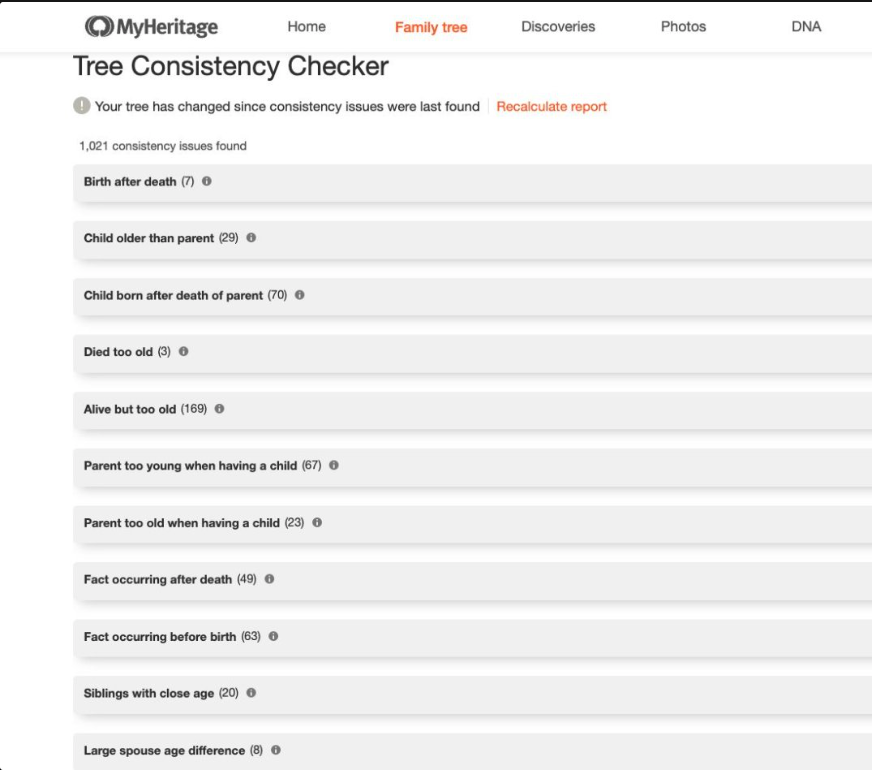
The platform provides an AI-powered Tree Consistency Checker tool that examines the family tree for inconsistencies. I have already run the tool and discovered 1021 inconsistencies. It would take hundreds of hours to find these otherwise and something I would never have time to do.
The potential to connect more dots than ever before.