NLP – A Programing Language for Our Biological Computers?
I just watched a video that explains a technique claiming a 95% healing success rate by drawing holographic images.
In the video, it explains how people were told to draw their imagined diseased organ in space, then draw the healthy version, and mentally move from the diseased to the healthy one.
I recognized it as pure NLP in action — something written about as early as the 1970s.
I’m starting to think that NLP forms the basis for describing a programming language for our biological computers.
Many years ago, I completed half the training to become a certified NLP practitioner. I never really practiced what I learned. I don’t think I truly understood it at the time. I was too insecure and had too many of my own issues to think about using it to help others.
Even though I didn’t complete the training, I was exposed to aspects of the second half through YouTube videos and enjoyed listening to Richard Bandler and others.
What is NLP used for?
When I first learned NLP, I didn’t really have a purpose for it. I mostly used it for fun party-trick demonstrations.
One example: using the classic NLP eye charts to tell if someone is lying. You tell them you can detect a lie and challenge them to tell you the color of various objects they own but lie about some of them.
Despite their best poker face, I could usually spot the lies almost every time.
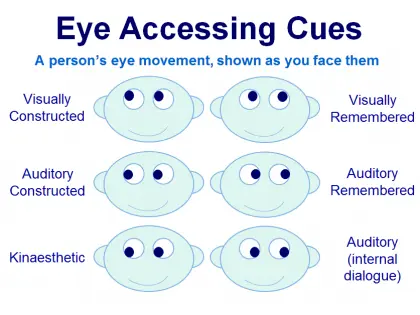
The NLP eye charts are just one of many tools to detect if someone is lying, congruent, or what state (mood) they are in. It teaches you how to read people, body language is a huge part of NLP.
This is why NLP is widely used by police forces around the world. They’re not taught formal NLP as that would be far too dangerous, as it might result in them thinking for themselves.
Instead, they’re taught isolated techniques for questioning and interrogation with no reference to NLP, though that’s where it originates.
A lie detector works because most people have little awareness, let alone control, over their reactions. Most responses come from Type 1 thinking – fast, automatic, and unconscious.
NLP is also widely used in sales, marketing, politics, and by anyone wanting to influence others whether for positive intent or personal gain. Because NLP is neutral a toolbox, not a philosophy.
If NLP is so influential, why have most people never heard of it?
Despite its massive (if hidden) adoption, NLP is not officially recognized or condoned — especially in areas where it could truly help people.
Take the famous Fast Phobia Cure (also known as the double dissociation technique), which Richard Bandler was known for.
People with lifelong phobias – the kind that cripple their lives, could be “cured” in one session by interrupting and reprogramming the mental pattern around the phobia.
Not everyone is cured in one session, of course. But even severe phobias are often resolved by NLP practitioners in just a few sessions.
And yet, despite the overwhelming evidence of its effectiveness, you can’t access an NLP practitioner through any official health system. Why? Because it isn’t officially recognized.
Instead, if you seek help with a phobia in the Western medical system, you’ll be referred to a psychologist using Cognitive Behavioral Therapy (CBT) and Exposure Therapy, which helps people “confront” their fears.
There are different types of Exposure Therapy:
- Flooding – The intense version, where someone is exposed to their fear all at once. (e.g., locked in a room with a spider.)
Sound sadistic? Primitive? - Systematic Desensitization – A more gradual approach using relaxation and incremental exposure.
Requires multiple session$ and frequent visit$.
CBT can get results eventually but it’s slow, overly analytical, and symptom-focused.
NLP is aimed at quick, pattern-level change breaking patterns, shifting perception, and getting results fast.
Rediscovering NLP
I soon forgot most of it and returned to old patterns – mostly Type 1 thinking. I didn’t intentionally use NLP anymore, but I recognize now that it’s influenced me in the background for many years.
Back when I studied NLP, I thought I understood the concepts — filters, “the map is not the territory,” and so on. And I did — at a superficial, intellectual level. Only recently, as I’ve started thinking about NLP again, has it really started to make sense.
Here’s are some of the important things I’ve come to understand about NLP:
NLP began as a study of excellence – identifying what works and creating a repeatable process others can copy.
NLP didn’t invent anything new. Most of it is borrowed: from other disciplines, techniques, traditions.
Its philosophy is pragmatic – use whatever works.
That means everything in NLP has real-world origins and applications.
NLP also had a huge influence on motivational speaking and self-help courses.
Many people featured in The Secret were NLP practitioners.
Names like Tony Robbins? Straight from NLP.
Over 90% of modern hypnotists came through NLP practitioner training.
Milton Erickson, considered the father of modern hypnosis, and the NLP certification training I did was under the The Milton H. Erickson Foundation.
NLP is about observation — internal and external.
It’s about recognising patterns.
It’s not a belief system. You don’t have to subscribe to any ideology to use it. You just have to be open and receptive — and avoid disbelief. Belief, after all, is the most powerful force in our reality.
There are countless offshoots of NLP today. I’ve barely scratched the surface. NLP is more like a scientific framework or a toolbox — one you can use to reprogram your brain.
So, back to that video…
What the doctor is doing is NLP in essence.
The NLP Techniques Being Used:
Swish Pattern
Mentally replacing an unwanted image (e.g., illness) with a desired one (e.g., health).
The unwanted image is shrunk or faded as the desired one becomes bigger, brighter, more dominant — usually with a quick “swish” motion.
Used to change automatic emotional responses.
Visual Dissociation
Often used for trauma and phobias. You visualize the problem from a distance (e.g., on a movie screen), reducing the emotional charge.
You can also “step into” a new scene where the issue is resolved.
Anchoring with Submodalities
Assigning sensory features and spatial locations to internal states.
This is essentially the “drawing organs in space” method — using location to assign meaning.
Here’s the thing: I understood these techniques intellectually.
But I never applied them in my life.
I suspect my ego was in the way.
Our Biological Computers did not come with a User Manaul because we don’t need one
Most people are looking for external guides.
But everything we need is within us — we just have to start asking.
For me, NLP is potentially the foundation for a programming language allowing us to take control of our Biological Computer
Maybe we’ve had total system admin access all along with full access to the field